
What Are Stress Relief Items, Really? A Practical Guide to What's Worth Keeping at Home
The Problem with Most Stress Relief Lists
Search "stress relief products" and you'll get a jumble: fidget cubes, bath bombs, weighted blankets, essential oil diffusers, adult coloring books, and a dozen other things with no explanation of why any of them belong on the same list. They're not all doing the same thing. Some work on your nervous system directly. Some work through scent. Some work because they give your hands something to do. And some, honestly, don't do much beyond looking good in a flat lay.
That matters, because buying the wrong thing doesn't just waste money — it reinforces the idea that nothing works. If you've ever bought a "stress relief" item that sat in a drawer after a week, it's probably because you didn't know what mechanism you actually needed.
This guide breaks stress relief items into honest categories, explains the basic mechanism behind each, and helps you figure out which ones are actually worth having at home.
Category 1: Physical / Thermal Relief
This is the category most people underestimate, and it's arguably the most direct route to calming the body down. Physical stress — the kind that shows up as tight shoulders, a stiff neck, or a dull ache behind the eyes — doesn't respond to mindset. It responds to touch and temperature.
Heat therapy works by increasing blood flow to tense muscles, which helps them physically relax and eases the pain signals that keep your nervous system on edge. Cold therapy does the opposite: it reduces inflammation and numbs acute discomfort. Both have a real, physiological effect on how your body registers stress.
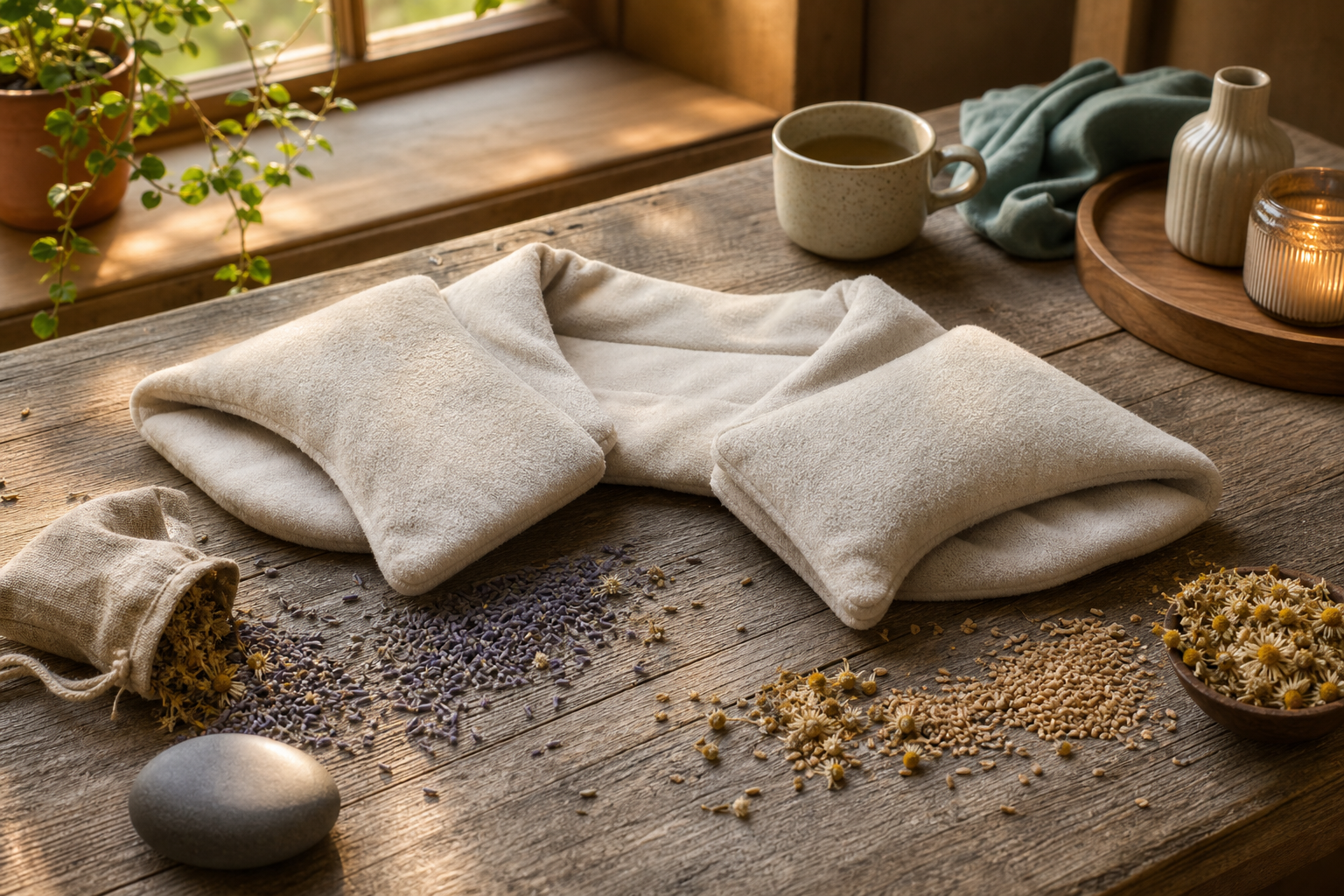
Herbal heat and cold wraps sit squarely in this category. A wrap draped over your neck and shoulders after a long day at a desk isn't just comfort theater — the warmth is doing something to the tissue underneath it. The same goes for cold therapy after a workout or an injury flare-up. The key is having something ergonomically shaped for the body part that actually holds your tension, not just a generic heating pad you balance awkwardly on your lap.
If your stress lives in your body — and for most people, it does — this is the category to prioritize. You can read more about how heat therapy works in practice in this post on warm compresses and heat therapy for natural pain relief.
Category 2: Olfactory / Aromatherapy
Scent is the one sense that bypasses the thalamus and connects directly to the limbic system — the part of the brain involved in emotion and memory. That's not wellness marketing; it's basic neuroanatomy. It's also why a particular smell can shift your mood in seconds before you've even consciously registered it.
This is why aromatherapy has genuine utility as a stress relief tool, not just as a nice-smelling room addition. The mechanism is real. What matters is delivery: a candle burning across the room is a different experience than a warm herbal wrap resting against your skin, where the heat actively releases the aromatic compounds from the herbs directly at the source of your tension.
Physician-formulated blends of aromatic herbs — the kind used in quality herbal wraps — are designed with this in mind. The herbs aren't decorative. They're chosen because their aromatic properties serve a purpose when activated by heat or cold. If you're interested in which herbs tend to show up in therapeutic blends and why, this guide to foundational herbs for a home apothecary is worth a read.
One honest caveat: aromatherapy works best as a complement to other stress relief methods, not a standalone fix for physical tension or chronic stress. Pair it with something physical and you get more than either alone.
Category 3: Sensory / Tactile Relief
Fidget spinners get mocked, but the underlying idea isn't wrong. Giving your hands or body a repetitive, low-demand sensory input can interrupt the loop of anxious thought by redirecting a portion of your attention. This is the same reason some people find knitting, or running worry beads through their fingers, genuinely calming.
Weighted blankets fall here too. The gentle, distributed pressure of a weighted blanket mimics something called deep pressure stimulation, which can activate the parasympathetic nervous system — your body's rest-and-digest mode. It's a real effect, though individual responses vary considerably.
The limitation of purely tactile items is that they address mental restlessness more than physical tension. If you're wound up from a stressful meeting, a fidget cube might help your mind settle. It won't do much for the knot in your trapezius.
Tactile items are worth having if your stress tends to be more anxious-mind than tight-body. They're least useful if you're carrying your stress physically and need something that acts on the tissue itself.
Category 4: Behavioral / Ritual-Based
This category is the most underrated, and also the easiest to dismiss as "not a real product." But the ritual around how you use something matters enormously. A deliberate, repeated wind-down sequence — heat the wrap, dim the lights, sit somewhere quiet for fifteen minutes — signals to your nervous system that the day is ending. Over time, that signal gets stronger, not weaker.
This is partly why a simple evening reset routine is more effective than a random collection of stress relief purchases. The consistency of the behavior is doing real work. A herbal wrap used every evening at the same time becomes part of that signal. A bath bomb used once a month doesn't.
Behavioral stress relief doesn't require buying anything new. It requires using what you have, consistently, in a way that your body learns to associate with safety and rest. For ideas on building that kind of routine, this post on simple evening reset routines lays out a practical framework.
Category 5: Cognitive / Distraction-Based
Adult coloring books, puzzles, journaling, reading — these work through a different mechanism entirely. They occupy the part of your brain that would otherwise be rehearsing tomorrow's to-do list or replaying an uncomfortable conversation. They don't resolve stress so much as interrupt it long enough for your nervous system to downshift.
This is genuinely useful, especially for people whose stress is driven more by mental rumination than physical tension. The honest limitation is that distraction is temporary. You set down the puzzle and the stress is still there. It hasn't been processed; it's been paused.
Cognitive tools work best when they're part of a larger toolkit — used alongside something that addresses the physical dimension of stress, not instead of it.
So What Actually Belongs in Your Home Toolkit?
The short answer: at least one item from the physical/thermal category, and at least one from behavioral. Those two together cover the most common stress presentations — body tension and mental restlessness — and they reinforce each other when used together.
Aromatherapy is a strong addition because it layers onto both: a good herbal wrap gives you thermal and olfactory benefits simultaneously, which is part of why it tends to feel more effective than either a plain heating pad or a diffuser alone.
Sensory and cognitive tools are genuinely useful for specific situations — anxious waiting, racing thoughts before bed, restless hands during a work call — but they're supporting players, not the foundation.
The question to ask before buying anything: where does my stress actually show up? In your body, your mind, or both? The answer tells you which category to reach for first.
A Note on Quality
Within any category, quality matters more than variety. One well-made herbal wrap that you reach for every day will do more for you than five mediocre gadgets that feel novel for a week. Look for items that are built to last, made from materials you're comfortable having against your skin, and designed for the specific body area you actually need to address. Ergonomic fit isn't a luxury feature — it's the difference between something you use and something you store.
Herbal Concepts' wraps are handcrafted in the USA with a physician-formulated blend of herbs and grains, and they're designed to work both hot and cold — so one item covers two of the most useful therapeutic modes. That's the kind of overlap that makes a product genuinely earn its place on a shelf.
Browse Herbal Concepts' full range of herbal heat and cold wraps — designed to address stress where it physically lives, with natural ingredients and no chemical shortcuts. Use code HERBALVIBES10 for 10% off your order.
Frequently Asked Questions
What's the difference between a heating pad and an herbal heat wrap?
A standard electric heating pad delivers heat, and that's it. An herbal heat wrap adds the aromatherapy dimension — as the herbs warm up, they release aromatic compounds that engage your olfactory system alongside the physical warmth. You're getting two mechanisms at once rather than one. Herbal wraps are also typically microwavable rather than plugged in, which means no cord and more flexibility in how and where you use them.
Can stress relief products actually help with physical pain, or are they just relaxation tools?
Physical and thermal stress relief tools — heat wraps, cold therapy, deep pressure — have real effects on muscle tissue, blood flow, and inflammation. They're not just comfort items. Heat increases circulation to tense muscles and can ease pain signals; cold reduces swelling and numbs acute discomfort. Whether that counts as "treating pain" depends on the source of the pain, but for tension-related aches and stress-induced muscle tightness, they're doing genuine physiological work.
How do I know which type of stress relief item is right for me?
Start by noticing where your stress shows up. If it's mostly physical — tight neck, sore shoulders, headaches, trouble sleeping because your body won't settle — prioritize thermal and physical tools. If it's mostly mental — racing thoughts, anxious rumination, restless energy — tactile and cognitive tools are more useful. Most people experience both, which is why a combination of a good herbal wrap (physical + olfactory) and a consistent evening ritual (behavioral) tends to cover the most ground.
Is it better to use heat or cold for stress-related muscle tension?
For chronic muscle tension — the kind that builds up over a stressful week — heat is generally the better starting point. It relaxes the muscle fibers and increases blood flow, which is what tight, overworked muscles need. Cold therapy is more useful for acute situations: a fresh injury, post-exercise inflammation, or a sinus headache. Many herbal wraps are designed to work both ways, so you can choose based on what your body is telling you that day rather than committing to one mode.