
Physical Self-Care vs. Mental Health Apps: Which Tools Actually Support Your Mental Health at Home?
The gap nobody talks about
You've probably downloaded at least one meditation app. Maybe you've tried journaling, deep breathing, or a guided sleep session. And if things have felt heavier, you may have looked into therapy or counseling. These are all genuinely useful things. But there's a moment — the one where your shoulders are locked up at 9 p.m., your mind is spinning, and you need relief right now — where most of those tools fall a little short.
That gap is where physical, sensory self-care lives. And it rarely gets a fair comparison against the apps and services that dominate the mental health conversation. So let's actually do that comparison — honestly, with trade-offs included.
What mental health apps do well (and where they stop)
Apps like guided meditation platforms, mood trackers, and breathing tools have real value. They're accessible, low-cost, and can help you build habits around awareness and regulation over time. If you're someone who responds well to structure and reminders, a good app can genuinely shift how you relate to stress across weeks and months.
The limitation is just as real, though. Apps require engagement. You have to open them, choose a session, sit still, and follow along — which is exactly the kind of effort that feels impossible when you're already overwhelmed. They work best as a preventive practice, not as an in-the-moment rescue. And for people who struggle to sit quietly with their thoughts, guided meditation can sometimes increase anxiety rather than ease it.
Apps are also entirely cognitive. They ask your mind to do the work of calming your mind — which is a bit like asking a sore muscle to massage itself.
What professional support does well (and where it stops)
Therapy, counseling, and other professional mental health services are the gold standard for working through deeper patterns, trauma, and chronic mental health conditions. A good therapist helps you understand why you respond the way you do, not just how to manage it in the moment. That depth is irreplaceable.
But professional support is also scheduled, bounded, and — for many people — expensive or hard to access consistently. You see your therapist once a week, maybe once a fortnight. The other six days, you're on your own. And the coping tools you build in session still need to be applied in real life, in real moments, without a professional in the room.
Professional support is the long game. It's not built for Tuesday at 11 p.m. when you can't sleep.
What physical, sensory tools do well (and where they stop)
This is the category that gets the least airtime in mental health conversations, which is strange because it's the most immediately accessible. Physical tools — warmth, scent, texture, gentle pressure — work through the body rather than the mind. And the body often responds faster.
Heat applied to tense muscles genuinely helps them release. Familiar, calming scents (lavender, chamomile, eucalyptus) can activate the parasympathetic nervous system — the branch responsible for rest and recovery. Sensory grounding, the practice of anchoring your awareness in physical sensation, is a well-established technique for interrupting anxiety spirals. Physical tools make all of this accessible without requiring you to be in the right headspace first.
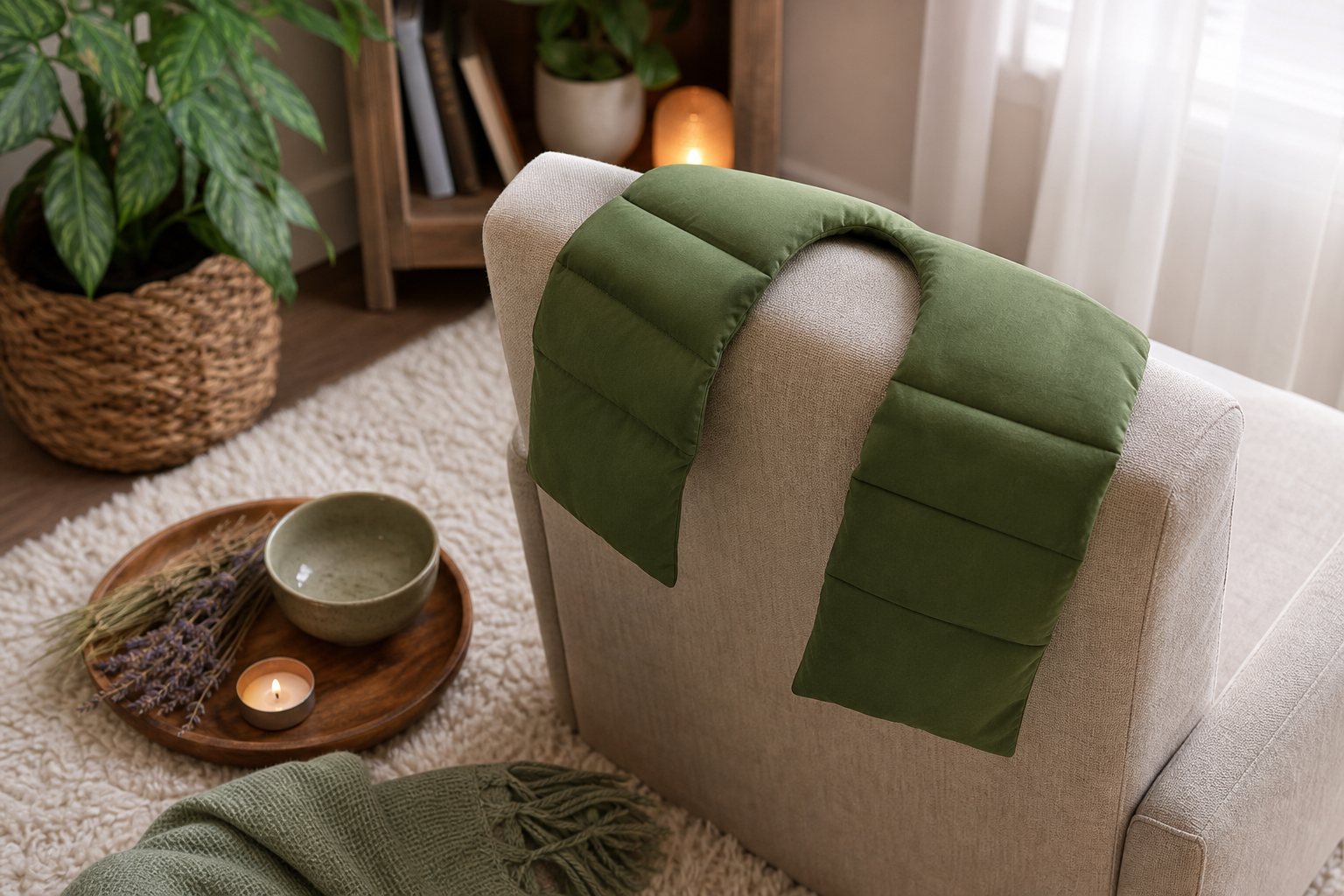
That's the key difference: a herbal wrap you drape across your shoulders doesn't need you to be calm to use it. It works while you're still stressed. The warmth and scent do the initial work, and your nervous system follows.
The honest limitation: physical tools don't build insight. They don't help you understand your patterns or work through underlying causes. They're not a substitute for therapy when therapy is what's needed. What they are is a genuinely useful bridge — something that meets you in the hard moment and makes the next hour more manageable.
A side-by-side look
| Tool type | Best for | Works in the moment? | Builds long-term skills? | Requires effort when stressed? |
|---|---|---|---|---|
| Mental health apps | Building habits, daily check-ins, mild anxiety | Sometimes | Yes, with consistency | Yes — you have to engage actively |
| Professional support | Deeper patterns, chronic conditions, trauma | No — it's scheduled | Yes — this is its strength | Yes — emotionally demanding work |
| Physical / sensory tools | Immediate relief, tension, stress spikes, sleep prep | Yes — this is its strength | Supports habits, not insight | Minimal — low barrier to use |
How to actually combine them
The mistake most people make is treating these categories as competing options — as if choosing an app means you don't need physical tools, or going to therapy means you've got it covered. They're not substitutes. They work at different speeds and on different parts of the problem.
A practical home toolkit might look like this: professional support for the underlying work, an app or journaling practice for daily awareness, and physical sensory tools for the moments in between — the tense commute home, the evening when you can't wind down, the morning when anxiety shows up before you've even had coffee.
That last category is where something like an herbal wrap earns its place. Draping a warm, herb-filled wrap across your neck and shoulders before bed isn't a replacement for anything — it's what makes the next step (the breathing exercise, the decent night's sleep, the clearer morning) actually reachable. If you're building out your home toolkit, heat therapy and mindfulness work particularly well together — the physical grounding makes the mental practice easier to access.
For the evenings when stress has built up and your body is carrying it, a structured evening reset routine that includes sensory tools can make a real difference in how you sleep and how you feel the next day.
The takeaway
No single tool covers everything. Apps build habits but can't reach you in the hard moment. Therapy does the deep work but isn't there every day. Physical, sensory tools are immediate and low-effort but don't replace insight. A complete home toolkit uses all three — and knowing which one to reach for, and when, is half the battle.
If physical, sensory support is something you want to add to your routine, explore Herbal Concepts' range of herbal wraps — tools designed for the moments when you need something immediate and tangible. Use code HERBALVIBES10 for 10% off your order.
Frequently Asked Questions
Can physical self-care tools like herbal wraps actually help with anxiety?
They can help manage the physical symptoms of anxiety — muscle tension, restlessness, difficulty winding down — by working through the body rather than asking your mind to calm itself. Warmth and familiar scents can activate the body's rest response, which makes other calming practices (breathing, sleep) easier to reach. They're not a treatment for anxiety disorders, but as a grounding, in-the-moment tool, they're genuinely useful.
Do I need to use all three types of tools, or can I just pick one?
You don't need all three, but they work at different speeds and on different parts of stress and mental health. If everyday tension and sleep are your main concerns, physical and sensory tools combined with a simple daily habit can go a long way. If you're dealing with deeper or persistent mental health challenges, professional support is worth prioritizing. Most people find that combining approaches — even just two — covers more ground than relying on one alone.
What makes herbal wraps different from a regular heating pad?
A standard electric heating pad delivers heat, and that's it. Herbal wraps add the dimension of aromatherapy — the herbs and grains inside release scent when heated, which engages the sense of smell alongside the physical warmth. Herbal Concepts wraps are filled with a physician-formulated blend of herbs, so the sensory experience is more complete than heat alone. They're also microwavable and don't require a power outlet, making them easy to use anywhere in the home.
When should I use a cold wrap instead of a warm one?
Cold therapy is generally more effective for acute inflammation — a fresh injury, a tension headache, or sinus pressure — where you want to reduce swelling and numb sharp pain. Heat works better for chronic muscle tension, stiffness, and stress-related tightness where increased circulation and relaxation are the goal. Many Herbal Concepts wraps are designed for both, so you can use the same wrap cold for a migraine and warm for an evening wind-down.