
How to Improve Hormone Health Through Your Body — Not Just Your Diet
Every hormone health article eventually circles back to the same list: eat more cruciferous vegetables, cut sugar, add seed cycling. And those things can genuinely help. But if you've cleaned up your diet and still wake up exhausted, still feel the tension headaches rolling in before your period, still can't seem to wind down at night — the problem probably isn't on your plate.
Hormones respond to your whole physical environment. What your nervous system is doing all day. How deeply you sleep. Whether your body is running chronically cold or perpetually inflamed. These inputs talk to your endocrine system just as loudly as food does, and they're the ones most people overlook.
Why Your Body's Physical State Drives Hormone Balance
Your hormones aren't produced in isolation — they're produced in response to signals. Cortisol rises when your nervous system detects threat. Melatonin rises when your brain senses darkness and a cooling body temperature. Progesterone is exquisitely sensitive to chronic stress. The whole system is designed to respond to your physical environment, not just what you ate for lunch.
This means that physical habits — the ones that shift your nervous system state, regulate your temperature, and improve sleep quality — are hormone interventions. They just don't get marketed that way.
Stress Load: The Hormone Disruptor Nobody Measures
Cortisol is your body's primary stress hormone, and in a healthy cycle, it's supposed to be high in the morning (to get you moving) and low by evening (to let you rest). When you're chronically stressed, that rhythm flattens. Cortisol stays elevated through the evening, which suppresses melatonin, raises your core body temperature, and competes with progesterone production — because both cortisol and progesterone are made from the same precursor. High stress, over time, can literally steal the raw material your body needs for reproductive hormones.
The fix isn't to eliminate stress — it's to build reliable daily moments that shift your nervous system from sympathetic (fight-or-flight) to parasympathetic (rest-and-digest). This is where physical, sensory inputs matter enormously. Warmth is one of the most effective parasympathetic triggers we have. Applied heat — particularly to the neck, shoulders, or abdomen — activates the vagus nerve, slows the heart rate, and tells your nervous system it's safe to stand down.
This isn't abstract. That feeling of your shoulders finally dropping when you put a warm wrap around your neck? That's your nervous system shifting gears. Done consistently, especially in the hour before bed, it can start to retrain the cortisol curve over time.
Sleep Quality: The Hormone Reset You Do Every Night (or Don't)
Most hormone repair happens while you sleep. Growth hormone is released in deep sleep. Melatonin orchestrates the overnight repair cycle. Leptin and ghrelin — the hormones that regulate hunger and satiety — reset during sleep. One or two nights of poor sleep can measurably shift insulin sensitivity, appetite signals, and cortisol patterns the following day.
The catch is that sleep quality depends heavily on what happens in the hour or two before you get into bed. Your core body temperature needs to drop slightly for sleep to initiate — and it can't do that if your nervous system is still running hot from the day. Screens, bright lights, and unresolved tension all keep that temperature elevated and delay the melatonin signal.
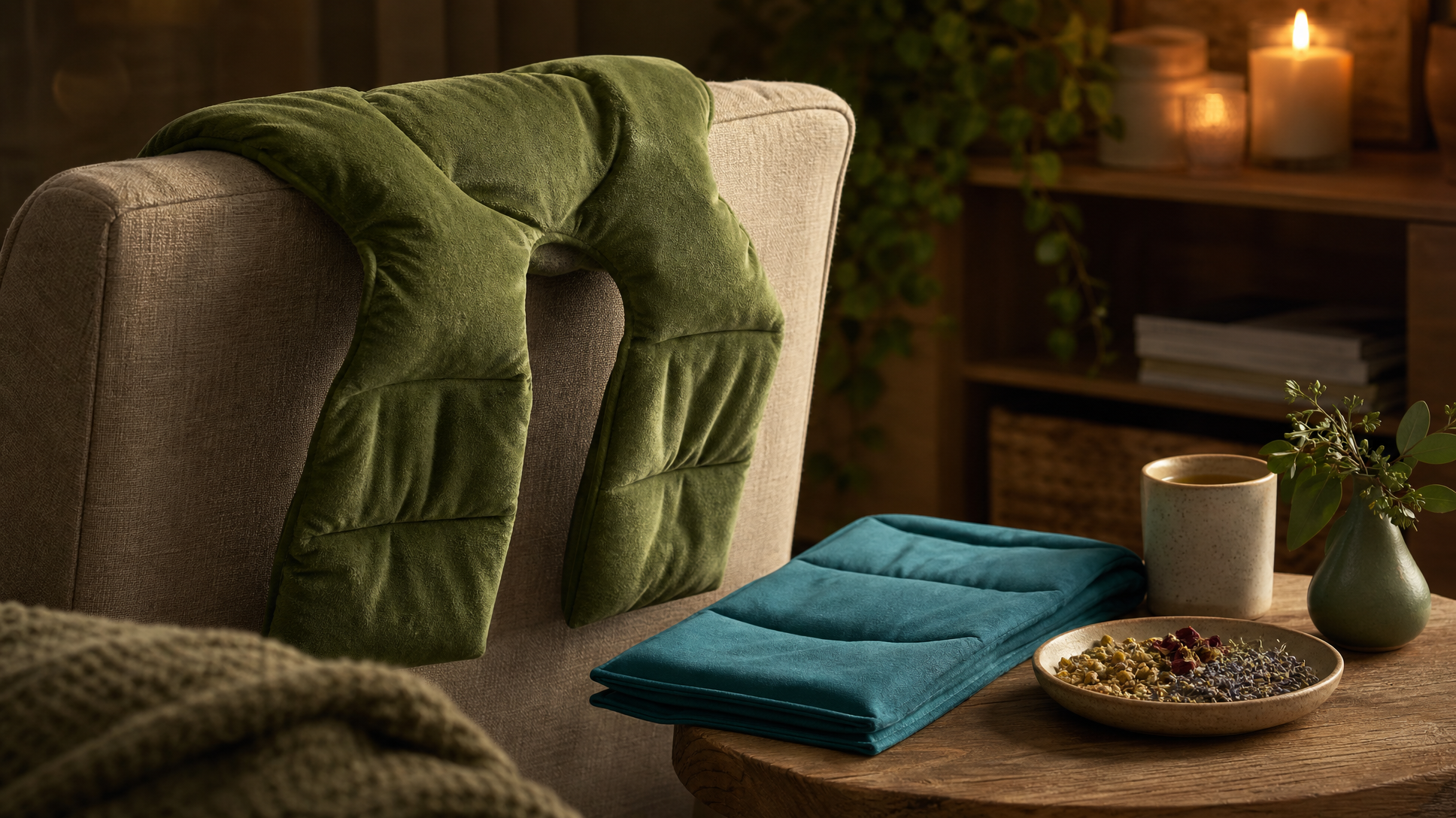
A warm herbal wrap used during a deliberate wind-down routine works with this biology, not against it. Heat applied to the body draws blood to the skin surface, which actually helps dissipate core heat — the same mechanism behind why a warm bath can help you fall asleep faster. Add the aromatherapy component of an herb-filled wrap, and you're giving your nervous system multiple simultaneous cues that it's time to slow down.
If you want to build this into a real routine, the post on simple evening reset routines is worth reading alongside this one — it goes deeper into structuring the hour before bed for better sleep and lower stress.
Body Temperature Regulation and Your Cycle
If you menstruate, your body temperature already shifts across your cycle — it rises slightly after ovulation and drops just before your period begins. This is normal and useful (it's how basal body temperature tracking works). But when the body is under chronic stress or dealing with inflammation, that temperature regulation becomes erratic, and the physical symptoms — cramps, tension headaches, poor sleep in the luteal phase — tend to worsen.
Targeted heat therapy during the luteal phase (the two weeks between ovulation and your period) can ease some of this. Heat applied to the lower abdomen or lower back helps relax uterine muscles, which is why a heating pad for cramps is such an old, reliable remedy. But the same logic extends upward: neck and shoulder tension often spikes before a period because circulating prostaglandins (the compounds that trigger cramping) also cause systemic muscle tension. A warm neck and shoulder wrap at that point isn't just comfort — it's addressing a real physiological pattern.
Cold therapy has a role here too. For hormonal headaches or sinus pressure that tends to appear mid-cycle or premenstrually, cold applied to the forehead or sinuses helps constrict blood vessels and reduce the throbbing quality of that kind of headache — a different tool for a different moment in the cycle.
How to Build a Hormone-Supportive Physical Routine
This doesn't need to be complicated. The goal is to give your body consistent physical cues — daily, not occasionally — that support a healthy cortisol rhythm, better sleep onset, and reduced muscular tension. Here's a simple framework:
Morning: Support the Cortisol Peak
Cortisol is naturally highest in the first hour after waking — this is called the cortisol awakening response, and it's supposed to happen. Don't suppress it with a stressful morning. Let it work by getting natural light, moving your body gently, and avoiding immediately diving into screens or high-stakes tasks. If you wake with neck or shoulder stiffness, a brief warm wrap session can loosen the muscles before you start your day.
Afternoon: Interrupt the Tension Buildup
The 3–4 p.m. window is when cortisol dips and many people hit a wall. Instead of reaching for another coffee (which can delay your evening cortisol drop), try a short physical reset: step away from your desk, stretch, and use a warm wrap on your neck and shoulders for ten minutes. It's a small interruption that prevents the tension from compounding into an evening headache.
Evening: Signal the Shift
This is the most important window for hormone health. About an hour before bed, dim the lights, put your phone down, and apply warmth — a herbal neck wrap, a back wrap, or comfort slippers filled with herbs that release their scent with heat. Let your body temperature start its natural descent. Keep the routine consistent; your nervous system learns patterns, and a reliable evening signal makes the cortisol-to-melatonin handoff smoother over time.
For women in the luteal phase or during menstruation, adding a lower back or abdominal wrap to the evening routine can ease the specific tension that builds during those days. Cold therapy — a chilled wrap on the forehead or sinuses — is worth keeping accessible for hormonal headaches that tend to appear predictably in your cycle.
The Practical Part
None of this requires a complicated wellness protocol. What it requires is consistency and a few reliable tools. Herbal wraps that work both hot and cold — microwavable for warmth, freezable for cold — cover most of what a hormone-supportive physical routine needs. The neck and shoulder wrap is the most versatile starting point for most people, since that's where tension accumulates most visibly. The back wrap is worth adding if lower back tension or cramping is part of your pattern. And if hormonal headaches are a recurring issue, the sinus and migraine cap used cold is a genuinely useful tool to have on hand.
You don't need all of them at once. Start with the body area where tension shows up first and build from there.
Hormone health isn't one intervention — it's a collection of daily physical inputs that either support your body's natural rhythms or work against them. Diet matters. But so does what you do with your body from the moment you wake up to the moment you fall asleep.
Explore Herbal Concepts' full range of herbal wraps and find the one that fits your routine at herbalconcepts.com. Use code HERBALVIBES10 for 10% off your order.
Frequently Asked Questions
Can heat therapy actually affect hormone levels?
Heat therapy doesn't directly raise or lower specific hormone levels, but it does influence the nervous system state that governs hormone production. Applied warmth activates the parasympathetic nervous system, which helps lower elevated cortisol and supports the conditions your body needs to produce and regulate hormones more effectively. Think of it as removing a barrier rather than adding a supplement.
When in my cycle is heat therapy most useful?
Many women find heat most helpful in the luteal phase (roughly the two weeks before their period) and during menstruation itself, when cramps, lower back tension, and hormonal headaches tend to peak. That said, using a warm wrap as part of an evening wind-down routine is beneficial throughout the cycle because it consistently supports better sleep and a lower cortisol baseline.
Is cold therapy or heat therapy better for hormonal headaches?
For most hormonal headaches — particularly the throbbing kind that comes premenstrually or mid-cycle — cold therapy tends to work better because it constricts blood vessels and reduces the pulsing sensation. Cold applied to the forehead, temples, or sinuses is the go-to. Heat is more useful for the neck and shoulder tension that often accompanies or precedes those headaches, so using both strategically (cold on the head, warm on the neck) can address the full picture.
How long should I use a herbal wrap in an evening routine?
There's no fixed rule, but even ten to twenty minutes of consistent warmth during a deliberate wind-down — lights dimmed, screens away — is enough to give your nervous system a meaningful parasympathetic signal. The key is doing it regularly rather than occasionally. Consistency is what trains the cortisol-to-melatonin handoff to happen more smoothly over time.