
What Are Heart Health Supplements Actually Doing — and What Role Does Stress Play That No Pill Can Fix?
The question most people skip
If you've ever typed "heart health supplements" into a search bar, you probably got a long list of ingredients — omega-3s, CoQ10, magnesium, berberine — and a lot of confident claims. What you likely didn't get was a straight answer about what those supplements are actually doing inside your body, or an honest accounting of what they can't do at all.
That second part matters more than most people realize. Because one of the most well-documented contributors to cardiovascular strain isn't a nutrient deficiency. It's chronic stress — the kind that accumulates in your muscles, disrupts your sleep, and keeps your nervous system running hot day after day. And no supplement touches that pathway.
This post is about both sides of the equation.
What heart health supplements are actually doing
Most heart health supplements work by targeting specific, measurable biological inputs: lipid levels, inflammation markers, oxidative stress, or electrical signaling in the heart muscle. They're filling gaps or nudging processes that are already happening in your body.
Omega-3 fatty acids, for instance, are studied for their role in triglyceride levels and inflammatory pathways. Magnesium is involved in hundreds of enzymatic reactions, including those that regulate heart rhythm and blood pressure. CoQ10 is a compound your cells use to produce energy, and its levels can decline with age or with certain medications. These are real mechanisms — not invented ones.
But here's the honest framing: supplements work on chemistry. They adjust inputs at the molecular level. They don't address the behavioral, mechanical, or nervous-system-level patterns that drive a significant portion of cardiovascular risk in everyday life.
A well-chosen supplement taken consistently can support a healthy cardiovascular system. It cannot undo the physiological effects of a body that's been locked in tension and stress response for months or years.
The stress pathway supplements can't reach
Chronic stress isn't just a feeling. It's a sustained physiological state. When your body perceives ongoing threat — whether that's a demanding job, poor sleep, chronic pain, or unrelenting muscle tension — it keeps producing stress hormones like cortisol. Over time, that sustained cortisol load has measurable effects: it influences blood pressure, promotes inflammation, disrupts sleep architecture, and keeps the sympathetic nervous system activated when it should be resting.
The cardiovascular system doesn't get a break during that cycle. Your heart rate stays slightly elevated. Vessels stay slightly constricted. Recovery — the kind that happens during genuine rest and sleep — gets compressed.
This is the pathway that supplements simply don't address. There's no capsule that tells your trapezius muscles to release, signals your nervous system to downshift, or replaces the restorative effect of genuine physical calm. Those inputs require a different kind of intervention — one that works through the body, not through digestion.
Research on the NIH's research databases has documented the relationship between chronic psychological and physical stress and cardiovascular outcomes for decades. The mechanism is not controversial. What's underappreciated is how much of that stress load is physical and muscular — accumulated tension from sitting, repetitive movement, poor posture, and inadequate recovery — rather than purely emotional.
Where heat therapy enters the picture
Heat applied to tense muscle tissue does something specific: it promotes vasodilation — widening of blood vessels — which increases local circulation and encourages the muscle to release its held contraction. That's not a wellness marketing claim; it's basic physiology. And when that release happens across major muscle groups like the neck, shoulders, and upper back, it sends a signal through the nervous system that it's safe to downshift.
That shift — from sympathetic activation toward parasympathetic rest — is exactly what the stress-cardiovascular loop needs interrupted. It's not a treatment for heart disease. But it's a meaningful, accessible way to reduce one of the chronic inputs that puts strain on the cardiovascular system in the first place.
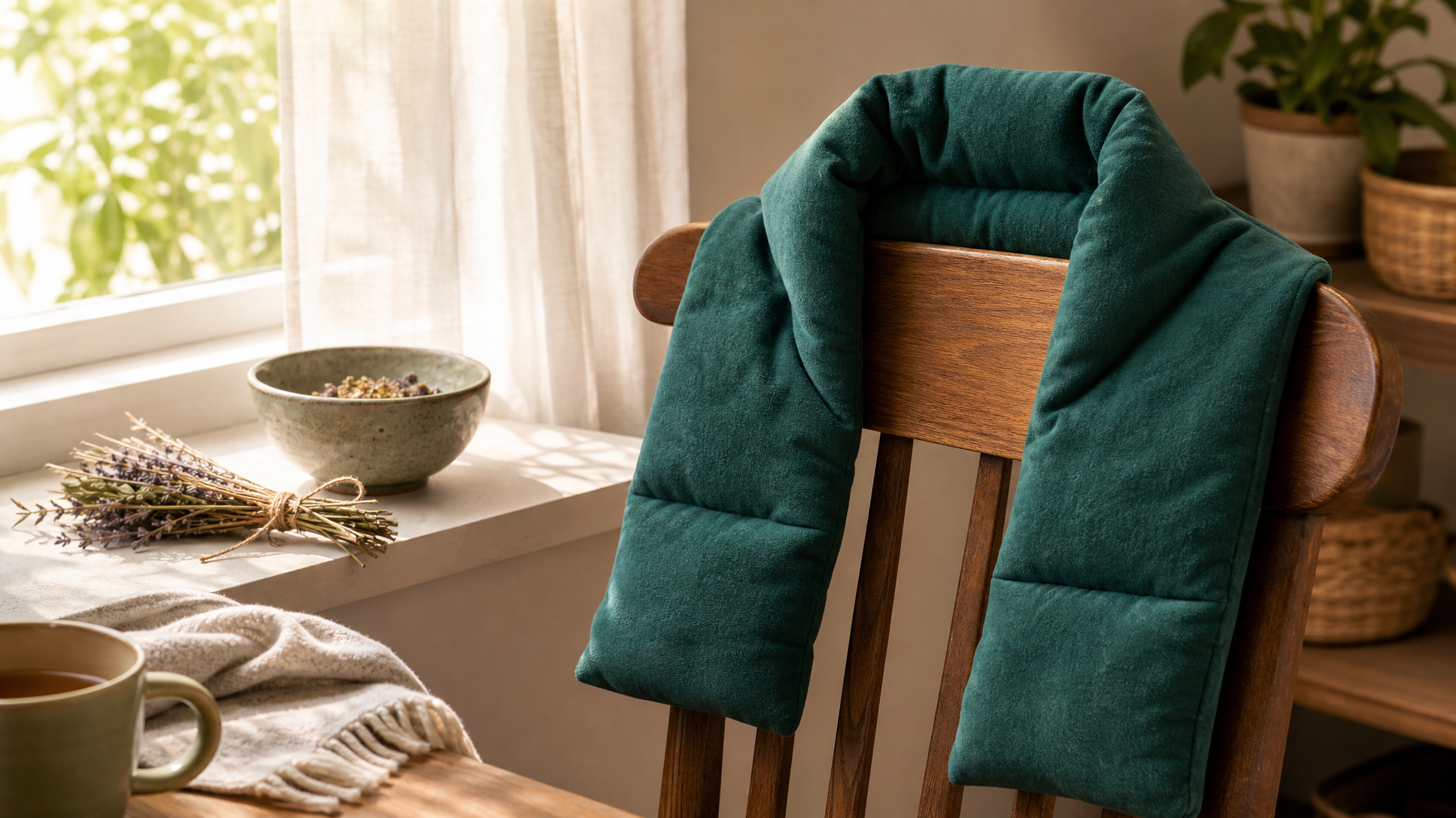
Herbal heat wraps add another layer to this. The aromatic herbs in a well-made wrap engage the olfactory system, which has a direct line to the limbic brain — the part that regulates emotional and stress responses. Lavender, chamomile, and similar herbs have been used for centuries in this context, and the mechanism (scent → limbic activation → parasympathetic response) is physiologically coherent. It's not magic. It's a sensory input that supports the same nervous system downshift that heat promotes mechanically.
How to actually use this in your daily routine
The goal isn't to replace any supplement or medical guidance. It's to address the part of cardiovascular wellness that supplements genuinely can't reach. Here's how to make that practical:
- Target your tension accumulation points. For most people, the neck, shoulders, and upper back are where chronic tension lives. These are also the areas closest to the vagus nerve — the main highway of the parasympathetic nervous system. A heated herbal neck and shoulder wrap applied for 15–20 minutes in the evening isn't just about comfort; it's a direct input into the stress-response system. Herbal Concepts' aromatherapy neck and shoulder wraps are designed specifically for this area.
- Use heat as a transition ritual, not a rescue tool. The biggest mistake people make is reaching for heat only when pain is acute. The more powerful use is as a consistent evening transition — something that signals to your body that the demanding part of the day is over. Consistency is what interrupts the chronic stress cycle, not occasional use.
- Don't overlook the feet and hands. Peripheral warming — heat applied to the hands and feet — is associated with the kind of core temperature drop that supports sleep onset. If poor sleep is part of your stress load (and it usually is), warming the extremities before bed can support the transition. Herbal Concepts makes foot wraps and hand heat pads designed for exactly this.
- Add cold therapy for acute inflammation. Heat isn't always the right tool. After a stressful, physically demanding day where inflammation is part of the picture, cold therapy can be more appropriate — reducing swelling and numbing acute discomfort before transitioning to gentle heat for relaxation. Many of Herbal Concepts' wraps are dual-use: microwave them for heat, or freeze them for cold. That flexibility matters for real-life use.
- Pair it with something else that supports parasympathetic activation. Heat therapy works best when it's not fighting against stimulation. Dim the lights, put the phone down, and let the wrap do its work in a quiet setting. Even ten minutes of genuine stillness with a heated herbal wrap is more effective than twenty minutes with the TV blaring and your phone in your hand.
For more on building an evening routine that genuinely supports recovery and sleep, the Simple Evening Reset Routines post is worth reading alongside this one. And if you're curious about the role heat plays in stress reduction more broadly, Heat Therapy and Mindfulness for Emotional Wellness goes deeper on the nervous system side.
The honest takeaway
Heart health supplements can be a legitimate part of a wellness strategy. If your doctor recommends one, or if you've done real research into a specific ingredient for a specific reason, that's a reasonable choice. But supplements address chemistry. They don't address the chronic physical tension, cortisol accumulation, and nervous system dysregulation that grind away at cardiovascular health in the background of daily life.
That part requires a body-level intervention. Something that works through sensation, warmth, and physical release — not through digestion. That's not a gap a better supplement formulation will ever close.
Addressing stress through the body is not the soft option. It's the part most people skip entirely because it doesn't come in a bottle.
Explore Herbal Concepts' full range of herbal heat and cold wraps — handcrafted in the USA with a physician-formulated blend of herbs and grains, and designed to work on the stress side of wellness that no supplement can reach. Use code HERBALVIBES10 for 10% off your order.
Frequently Asked Questions
Can heat therapy actually reduce cardiovascular risk?
Heat therapy isn't a treatment for heart disease, and it shouldn't be framed as one. What it can do is support the stress-reduction side of cardiovascular wellness — by promoting muscle relaxation, encouraging parasympathetic nervous system activity, and helping interrupt the chronic cortisol cycle that contributes to cardiovascular strain over time. It's a supportive tool, not a medical intervention.
Are herbal heat wraps safe to use every day?
For most healthy adults, using a herbal heat wrap daily as part of an evening wind-down routine is perfectly reasonable. Always follow the product's instructions for heating times and test the temperature before applying to skin. If you have a specific medical condition affecting circulation or skin sensitivity, check with your doctor first.
What's the difference between a herbal heat wrap and a regular electric heating pad?
A herbal heat wrap — like those made by Herbal Concepts — is filled with a blend of herbs and grains that retain and radiate moist heat, which tends to penetrate more gently and evenly than the dry heat from an electric pad. The herbs also release aromatic compounds when warmed, engaging the olfactory system in a way that supports relaxation. Electric pads offer adjustable temperature control, which has its own advantages, but they don't provide the aromatherapy component.
When should I use cold therapy instead of heat?
Cold therapy is generally more appropriate for acute inflammation — swelling, fresh injury, or areas that feel hot to the touch. Heat works better for chronic tension, stiffness, and muscle aches where you want to increase circulation and encourage release. Many Herbal Concepts wraps are dual-use, so you can freeze them for cold therapy and microwave them for heat, giving you both options depending on what your body needs that day.