
Wearable Health Devices Benefits: What the Data Tracks — and What It Can't Fix
Your wearable knows you're tense. It just can't do anything about it.
You glance at your wrist and the app confirms what you already felt: elevated heart rate, poor sleep score, stress levels flagged red. The device has done its job perfectly. And yet your shoulders are still knotted, your neck still aches, and you're no more rested than you were before you checked. That gap — between knowing and actually feeling better — is the honest limitation that no wearable company puts on the box.
This isn't a case against wearables. The data they collect is genuinely useful. But understanding what they measure, what that measurement means, and what you still need to do with your body is the difference between a useful tool and an expensive anxiety generator.
What Wearables Actually Track (and Why It Matters)
Modern wearable health devices — fitness trackers, smartwatches, rings — primarily measure a handful of physiological signals: heart rate, heart rate variability (HRV), skin temperature, blood oxygen saturation, movement patterns, and sleep stage estimates. Each of these is a proxy, not a direct reading of how you feel.
Heart rate variability is probably the most meaningful. HRV reflects how well your autonomic nervous system is balancing its two branches — the sympathetic (fight-or-flight) and parasympathetic (rest-and-digest). A low HRV reading generally suggests your body is under load: physical stress, poor recovery, or emotional strain. It doesn't tell you why, and it certainly doesn't reduce the load itself.
Skin temperature can flag illness onset or hormonal shifts, but it's a surface reading. Sleep staging is estimated from movement and heart rate patterns — useful for spotting trends over weeks, but not a clinical sleep study. Step counts and active minutes are the most straightforward metrics, though even these are approximations depending on how the device is worn and calibrated.
The value of all this data is pattern recognition over time. If your HRV drops every Sunday night and your sleep score tanks on Mondays, that's a real signal worth acting on. Wearables are good at surfacing those patterns. What they can't do is act on them for you.
The Line Between Measuring and Relieving
Here's where most wearable conversations quietly skip over something important: a sensor is passive. It observes. The moment you close the app and put your phone down, the tension in your trapezius muscles is still there. The cortisol from a stressful afternoon is still circulating. The stiffness in your hands from hours of typing hasn't moved.
Wearables are excellent diagnosticians in the loose sense — they tell you something is off. But the actual work of recovery happens in the body, through physical intervention: movement, rest, warmth, cold, and time. No algorithm delivers that.
This is worth sitting with, because a lot of people — especially those who lean toward data and optimization — can find themselves checking metrics obsessively without actually doing the restorative thing the metrics are asking for. The watch says "recovery needed." The body agrees. The fix isn't another check-in; it's putting something warm on your neck and lying down for twenty minutes.
Where Thermal Therapy Picks Up Where Data Leaves Off
Heat and cold therapy work at a physical level that no wearable can replicate. Warmth applied to a tense muscle group increases local circulation, relaxes the surrounding tissue, and signals the nervous system to downshift. Cold therapy, used after acute strain or inflammation, helps reduce swelling and numb sharp pain. Both have been used therapeutically for centuries — not because they're trendy, but because they work directly on the tissue.
The practical challenge has always been convenience. A hot water bottle slips. An ice pack is too cold and too wet. Electric heating pads tether you to a wall outlet. What actually fits into a real evening — or a real workday — is something you can heat in two minutes, drape over your neck or shoulders, and forget about while you decompress.
That's the design logic behind herbal wraps. Filled with a physician-formulated blend of herbs and grains, they hold heat (or cold) evenly and conform to the body rather than sitting stiffly against it. The aromatherapy component — released gently as the wrap warms — adds a sensory layer that helps shift the nervous system toward calm. It's not a replacement for medical care when something is seriously wrong, but for the everyday tension your wearable keeps flagging? It's a direct, physical answer.
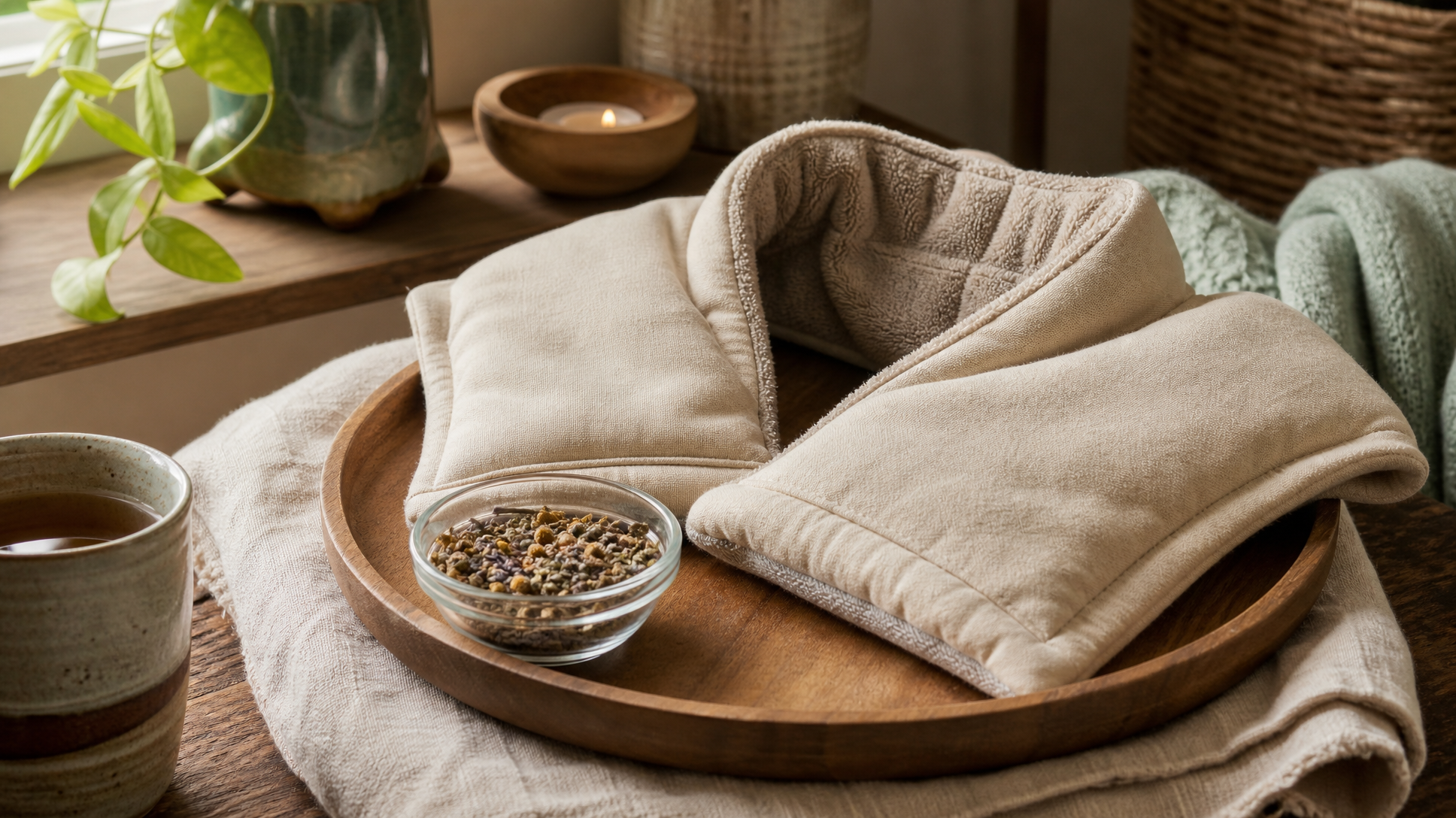
Herbal Concepts makes wraps shaped for the specific areas where tension accumulates most: the neck and shoulders, the back, the hands, the feet, and even the sinuses. The idea is that your wearable might tell you your stress is elevated — and a wrap gives you something concrete and immediate to do about it, without a prescription or a power cord.
If you want to understand more about how heat therapy works alongside a daily wellness routine, this guide on heat therapy and mindfulness goes deeper into the physical and emotional side of the practice.
A Simple Framework: Data Informs, Action Heals
Think of it this way. Your wearable is the check engine light. It tells you something needs attention. What you do next is the actual maintenance.
- HRV low, sleep poor? That's your nervous system asking for downtime. A warm neck or shoulder wrap during a wind-down routine gives your body a physical cue that the day is over.
- Stress score elevated after a long desk session? Tight hands and forearms are often the overlooked culprit. Herbal hand wraps or foot wraps can help release that held tension while you rest.
- Recovery flagged after physical exertion? Cold therapy on sore joints or muscles in the first day or two, then warmth as the acute phase passes — the same dual-use wraps handle both.
None of this requires a complicated protocol. The point is to let the data prompt action rather than just anxiety — and to make that action as low-friction as possible.
What Your Wearable Can't Replace
It's worth being honest about the other direction too. A herbal wrap is not a fitness tracker. It won't tell you whether your resting heart rate has trended upward over three months, or whether your sleep efficiency has improved since you changed your evening routine. For that kind of longitudinal self-knowledge, wearables are genuinely valuable.
The two tools aren't competing. They're addressing different parts of the same problem. One measures. The other acts. Used together — your device surfacing the pattern, your wrap addressing the physical reality — you actually close the loop that most wearable users leave open.
If you're building out a more intentional evening routine around this idea, the post on simple evening reset routines is worth reading alongside this one.
The Honest Bottom Line
Wearable health devices are genuinely useful. They make invisible physiological patterns visible, and that visibility can motivate real behavior change. But the data stops at the skin. The tension in your muscles, the ache in your joints, the nervous system that won't quiet down — those need something physical, something warm, something that actually touches the body.
Your wearable can tell you exactly how stressed you are. A good herbal wrap can actually do something about it.
Ready to close the loop? Explore Herbal Concepts' full wrap range — the hands-on complement to your wearable's data. Use code HERBALVIBES10 for 10% off your order.
Frequently Asked Questions
Can herbal wraps be used every day alongside a wearable wellness routine?
Yes. Herbal heat and cold wraps are designed for regular, everyday use. They're a passive, non-pharmaceutical tool — you heat or chill the wrap and apply it to the area of tension for a period of time. Because they contain no chemicals or medications, they're well-suited to becoming a daily wind-down or recovery ritual rather than an occasional treatment.
What does heart rate variability (HRV) actually tell you about stress?
HRV measures the variation in time between consecutive heartbeats. A higher HRV generally indicates that your autonomic nervous system is well-recovered and balanced; a lower HRV suggests your body is under stress — physical, emotional, or both. It's a useful trend metric over days and weeks, but a single reading in isolation doesn't tell the full story. Think of it as one signal among several, not a definitive verdict.
When should I use heat versus cold therapy for muscle tension?
A general rule of thumb: cold therapy is better suited to the first day or two after an acute injury or intense exertion, when inflammation and swelling are the main concern. Heat is more appropriate for chronic tension, stiffness, and general muscle tightness — it increases circulation and relaxes tissue. Many herbal wraps are designed to work both ways, so you can use the same wrap chilled for acute relief and warmed for ongoing tension, depending on what your body needs.
Do herbal wraps work for the same stress signals that wearables detect?
Not in a direct, measurable way — and that's not really their job. Wearables detect physiological signals like HRV and skin temperature. Herbal wraps address the physical tension and discomfort those signals often reflect: tight muscles, stiff joints, and a nervous system that needs a sensory cue to downshift. They work at the body level rather than the data level, which is why they complement wearables rather than compete with them.