
Mindfulness Meditation at Home: Why Warming Your Body First Makes It Actually Work
You sit down to meditate. You close your eyes. You try to focus on your breath. And then your shoulders creep up toward your ears, your neck feels like a knotted rope, and your mind is cataloguing every ache instead of settling into stillness. Five minutes later, you give up and check your phone.
That's not a willpower problem. It's a sequencing problem.
Most mindfulness guides assume your body is already calm before your mind tries to follow. They're not. Physical tension — especially in the neck, shoulders, hands, and feet — keeps your nervous system in a low-grade alert state that makes genuine mental quiet almost impossible to reach. The body has to come first.
Why Physical Tension Blocks Mental Stillness
When muscles are tight and cold, your body reads that as stress. The nervous system responds accordingly, staying primed rather than winding down. Heat works in the opposite direction: warmth encourages blood vessels to dilate, muscles to soften, and the body to shift toward a more relaxed state. That physical shift creates the conditions where slowing the mind becomes genuinely possible — not just something you're forcing.
This is the logic behind heat therapy as a pre-meditation tool. You're not replacing the meditation; you're clearing the runway so it can actually land. Research on thermotherapy and relaxation consistently points to warmth as a meaningful signal to the nervous system that it's safe to downregulate. Pair that with the grounding scent of aromatic herbs, and you're working on two sensory channels at once — touch and smell — before you even attempt to quiet your thoughts.
The Pre-Meditation Body-Warming Sequence
This isn't a complicated ritual. It takes about ten minutes before you sit, and the payoff is a meditation session that feels different from the first breath — softer, more reachable, less like a battle.
Step 1: Start With the Neck and Shoulders (5–7 minutes)
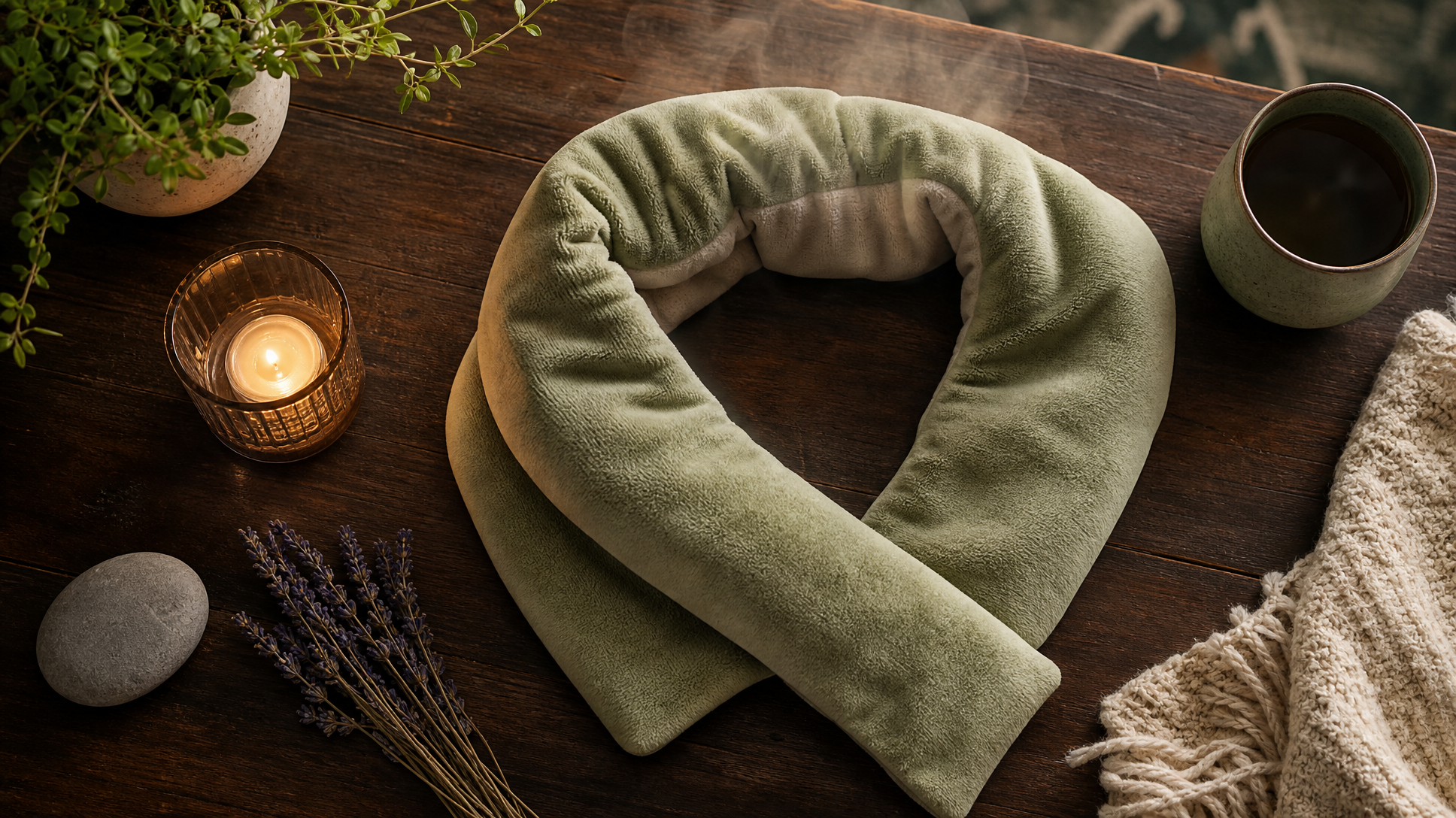
The neck and shoulders are where most adults hold the day. Hours at a desk, stress, poor posture — it all pools there. Draping a warmed herbal neck and shoulder wrap across the back of your neck before you sit is the single highest-impact thing you can do to prepare for meditation. The weight of the wrap adds gentle pressure, the heat softens the muscle tissue, and the herbal aromatherapy begins doing its quiet work on your senses.
Let it sit while you dim the lights, put your phone face-down, and do nothing else. That transition time is part of the practice. Explore the Aromatherapy Neck and Shoulder Wrap collection if you want to see what this looks like in practice.
Step 2: Warm the Hands (2–3 minutes)
Cold hands during meditation are a subtle but persistent distraction. You'll notice them when everything else quiets down, and then you're thinking about your hands instead of your breath. A brief warm compress on the palms — or herbal hand heat pads — takes that variable off the table entirely. Warm hands also tend to signal safety to the nervous system in the same way a warm room does.
Step 3: Ground Through the Feet (2–3 minutes)
Feet are easy to ignore until they're cold and uncomfortable, at which point they become the only thing you can think about. Slipping on a pair of warmed herbal comfort slippers while you complete your neck warm-up closes the loop from top to bottom. There's something genuinely grounding about warmth in the feet — it draws attention downward and out of the overactive head, which is exactly where you want it before meditation begins.
Check out the Foot Wraps collection for options designed for this kind of use.
Step 4: Sit — and Let the Wrap Stay On
Keep the neck wrap on as you move into your meditation position. You don't have to remove it. The continued warmth and scent become an anchor — a sensory cue that signals to your brain: this is the wind-down time. Over days and weeks, that association deepens. The wrap becomes part of the ritual, and the ritual becomes easier to enter.
A Note on Scent as a Meditation Anchor
Aromatherapy isn't just pleasant — it's one of the fastest routes to a shifted mental state because scent bypasses the thinking brain and connects directly to the limbic system, the part of the brain involved in emotion and memory. Herbal wraps that carry the scent of aromatic herbs do this passively, without any effort on your part. You heat the wrap, you put it on, and the scent is already working while you're still settling in.
This is worth leaning into deliberately. If you use the same herbal wrap every time you meditate, your brain will begin to associate that specific scent with calm. Eventually, the smell alone starts to ease the transition — a conditioned response that makes the practice easier to return to, especially on difficult days.
How Often Should You Do This?
Consistency matters more than duration. A ten-minute warm-up followed by a ten-minute sit, done four or five times a week, will build a more reliable practice than an occasional hour-long session you dread starting. The body-warming sequence is low-effort enough that it removes the main excuse for skipping — the friction of getting into the right headspace. When the wrap goes on, the session has already begun.
If you're building out a broader evening routine around this, the post on simple evening reset routines is worth reading alongside this one. The two approaches layer well.
One Thing to Avoid
Don't heat a wrap and then immediately rush into a formal meditation posture with a timer running. That urgency is the opposite of what you're trying to create. The warm-up period is the transition — use it as one. Sit somewhere comfortable, let the heat do its work, and only move into your meditation position when you feel the first genuine softening in your shoulders. That's the signal your body is ready.
The meditation itself can be whatever works for you — breath focus, a body scan, a guided session. The point of this post isn't to prescribe a technique. It's to fix the part that most guides skip: getting your body into a state where any technique can actually work.
Ready to build a warm-up ritual that makes your practice stick? Explore the full range of herbal heat wraps at Herbal Concepts and find the one that fits your wind-down routine — neck, hands, feet, or all three.
Frequently Asked Questions
How long should I heat the herbal wrap before meditating?
Follow the heating instructions that come with your specific wrap — times vary by product and microwave wattage. As a general rule, heat it until it's comfortably warm to the touch, not hot. You want sustained, gentle warmth that you can keep on throughout the session, not an intense heat that fades quickly or requires you to remove it.
Can I use cold therapy instead of heat before meditation?
Cold therapy is excellent for reducing inflammation and acute pain, but it's generally less effective as a pre-meditation tool. Cold tends to activate the nervous system rather than calm it, which is the opposite of what you're trying to achieve before sitting. Stick with heat for the wind-down sequence — save cold therapy for post-exercise recovery or acute flare-ups.
What if I only have time for a short session — is the warm-up still worth it?
Yes, and it might matter even more. A five-minute meditation that you actually drop into is worth more than fifteen minutes of sitting with a tense body and a restless mind. Even two or three minutes with a warm neck wrap before a short sit can meaningfully change the quality of those minutes. Don't skip the warm-up to squeeze in more meditation time — it's not a trade-off that works in your favor.
Is it safe to fall asleep with a herbal heat wrap on?
It's best not to. Herbal heat wraps are designed for conscious, supervised use — falling asleep with one on can lead to overheating or discomfort. If your meditation transitions into sleep (which is a good sign your nervous system is finally relaxing), remove the wrap first or set it aside before you fully wind down. The goal is rest, not risk.