
Is Magnesium for Sleep Better Than Melatonin? What Each One Actually Does — and What You Might Be Missing
If you've ever swapped melatonin for magnesium and still found yourself staring at the ceiling at midnight, you already know the frustrating truth: neither one is a guaranteed off switch. The question isn't really which supplement wins — it's whether you understand what each one actually does, and whether you're missing something else entirely.
Let's get into it honestly.
What Melatonin Actually Does
Melatonin is a hormone your brain's pineal gland naturally produces as light fades in the evening. It signals to your body that it's time to wind down — not that it's time to sleep. That distinction matters more than most sleep content admits.
Supplemental melatonin works best when your internal clock is off — jet lag, shift work, or staying up too late for too many nights in a row. In those cases, a low dose taken at the right time can nudge your rhythm back into place. What it doesn't do particularly well is help you stay asleep, or calm the kind of wired, racing-mind tension that keeps a lot of people up on a normal Tuesday.
Taking a large dose doesn't make it work harder. It just means more melatonin circulating in your blood than your body knows what to do with — which is partly why some people wake up groggy.
What Magnesium Actually Does
Magnesium plays a different role entirely. It's a mineral involved in hundreds of processes in the body, including the regulation of the nervous system. It supports the activity of GABA, the neurotransmitter responsible for quieting neural activity — the biological equivalent of turning down the volume on a noisy room.
For people whose sleep struggles are rooted in tension, anxiety, or an inability to physically relax, magnesium addresses the mechanism more directly than melatonin does. It doesn't tell your clock what time it is. It helps your nervous system let go.
That said, magnesium isn't a sedative. If your sleep is disrupted by pain, temperature, stress hormones, or a racing mind that kicks in the moment you lie down, magnesium alone won't solve it.
So Which One Is Better?
They're not really competing. They work on different systems — melatonin on circadian timing, magnesium on nervous system tone. The better question is: which one matches your actual problem?
- If your issue is falling asleep at the right time, or recovering from travel and disrupted schedules, melatonin is the more targeted tool.
- If your issue is physical tension, restlessness, or the kind of stress that makes your muscles hold on even when you're exhausted, magnesium addresses that more directly.
- If your issue is both — which is common — neither one alone is likely to feel like a complete answer.
And here's what most sleep content skips over entirely.
The Third Piece Most Sleep Routines Are Missing
Your body prepares for sleep through a process called thermoregulation. As you approach sleep, your core body temperature naturally drops — and that drop is part of what triggers the cascade of physiological changes that carry you into deep sleep. One of the most effective ways to support that process is to apply gentle warmth to the neck and shoulders before bed.
It sounds almost too simple. But warmth applied to the upper body draws blood toward the surface of the skin and away from the core, which actually accelerates that natural cooling process. It also directly relaxes the muscles that carry the most tension through a long day — the neck, the trapezius, the tops of the shoulders — which are exactly the muscles that keep a lot of people from ever fully settling.
This is a completely different pathway from anything a supplement touches. Melatonin works on your brain's clock. Magnesium works on your nervous system chemistry. Warmth works on your muscles, your circulation, and your body's physical transition into sleep — all at once, and without anything to swallow.
Add herbal aromatherapy into that warmth — the kind that releases naturally as the wrap heats — and you're also engaging your olfactory system, which has a direct line to the brain's limbic region, the seat of emotional regulation and stress response.
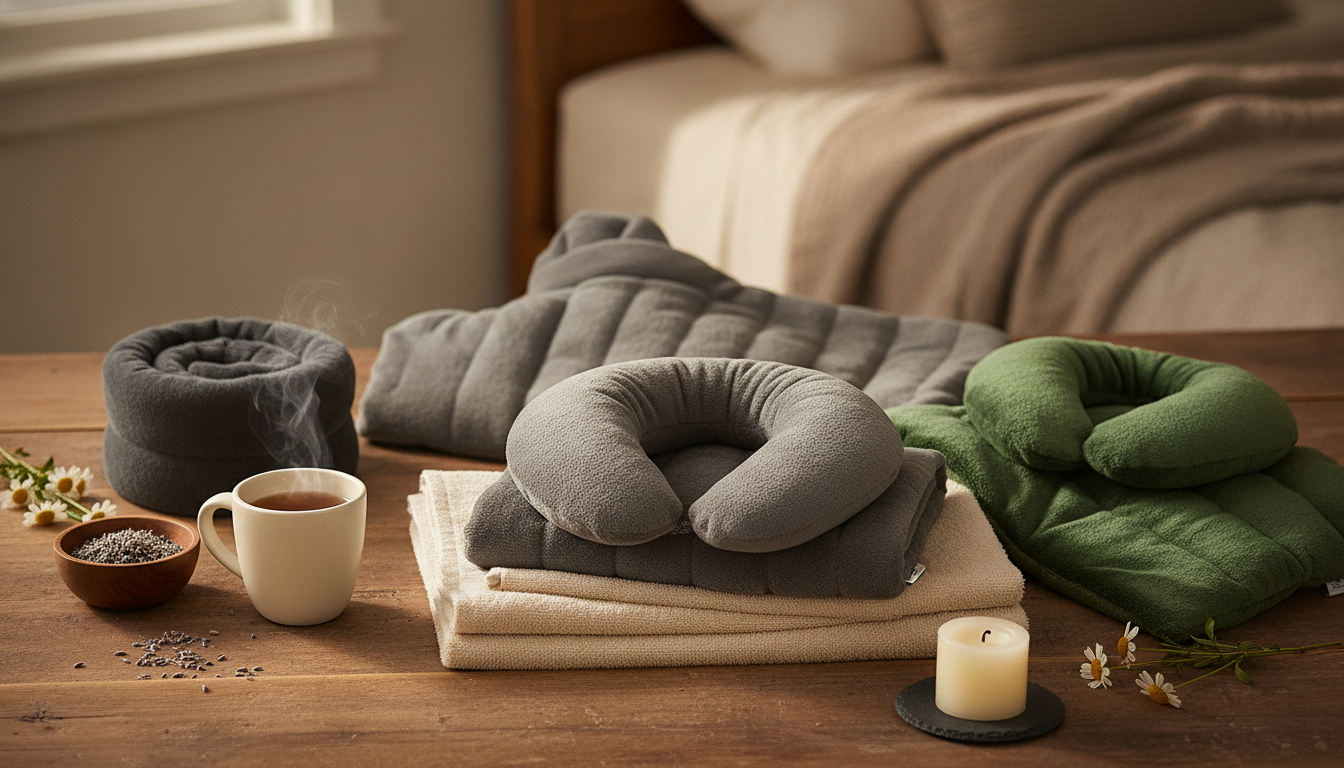
Four Herbal Neck and Shoulder Wraps Worth Knowing
If you want to bring this into your wind-down routine, here are four options from Herbal Concepts that are worth considering — each one a little different depending on what you're looking for.
1. Soothing Herbal Neck & Shoulder Wrap – Hot/Cold Aromatherapy
This is the one most people start with, and for good reason. The wrap is generously sized — it sits across the neck and drapes over both shoulders, which means it covers the exact area where tension accumulates through a day of desk work or screen time. Made with soft plush fabric and filled with a natural herbal blend, it goes in the microwave for heat therapy or the freezer for cold. The weight of it settling across your shoulders has its own calming effect before the warmth even kicks in. Browse the full Aromatherapy Neck and Shoulder Wrap collection to see all available options.
2. Neck Wrap | Microwavable Neck Wrap | Heating Wrap for Neck
If your tension lives specifically in the neck — the base of the skull, the cervical vertebrae, the muscles that run up either side — this wrap is shaped to sit more closely around the neck itself. It's a focused option for people who find that broader shoulder wraps don't apply enough concentrated warmth to the spot that actually hurts. Heat it briefly in the microwave and drape it around your neck while you read, meditate, or simply sit quietly before bed.
3. Luxury Wrap Hot/Cold Aromatherapy with 12 Herbs & Essential Oil
The standout here is the herbal blend — 12 herbs combined with essential oil, which means the aromatic release when warmed is noticeably richer than a single-herb product. If the aromatherapy component matters to you (and for sleep preparation, it genuinely can), this is the version to consider. The sensory experience of settling in with this wrap is closer to a spa treatment than a home remedy, which is part of the point if your goal is signaling to your nervous system that the day is done.
4. Neck & Back Wrap Hot/Cold Aromatherapy with 12 Herbs & Essential Oil
This one extends the coverage further — neck and back, rather than neck and shoulders alone. If you carry tension down through the mid-back, or if you want a single wrap that addresses a larger area during your wind-down, this is the most comprehensive option of the four. Like the Luxury Wrap, it uses the 12-herb blend with essential oil, so the aromatic warmth is present throughout.
How to Layer All Three
If you're using magnesium or melatonin already, a herbal wrap doesn't replace either — it works alongside them through a different mechanism. A simple stack that covers all three pathways might look like this: take your supplement of choice roughly an hour before you want to sleep, dim the lights, and spend the last twenty minutes or so with a warm herbal wrap across your neck and shoulders. Let the warmth do its work on your muscles while the herbs do theirs on your senses.
The goal isn't to find the one thing that fixes sleep. It's to stop leaving the physical, sensory part of wind-down out of the equation entirely — because for a lot of people, that's exactly the piece that's been missing.
Ready to add it to your routine? Shop the Soothing Herbal Neck & Shoulder Wrap at Herbal Concepts and use code HERBALVIBES10 for 10% off your order.
If you want to explore more about building a calming evening routine around natural tools, the post on simple evening reset routines is a good next read — and heat therapy and mindfulness for emotional wellness goes deeper on exactly why warmth works the way it does.
Frequently Asked Questions
Can I use a herbal neck wrap and take magnesium on the same night?
Yes — they work through completely different mechanisms, so there's no conflict. Magnesium supports nervous system relaxation through its effect on GABA activity, while a warm herbal wrap works on muscle tension, circulation, and sensory calming through aromatherapy. Using both together means you're addressing more than one pathway at the same time, which is often more effective than relying on a single approach.
How long should I heat a herbal neck wrap before bed?
Heating times vary by wrap and microwave wattage, so always follow the specific instructions that come with your product. As a general guide, most herbal wraps are warmed in short intervals — checking the temperature between each — until they reach a comfortable, soothing warmth rather than intense heat. When in doubt, slightly cooler and comfortable is always safer than too hot.
Is melatonin safe to take every night?
This is a question best answered by your doctor or pharmacist based on your individual situation. Generally speaking, melatonin is considered a short-term tool for resetting your sleep schedule rather than a nightly supplement taken indefinitely — but guidelines vary. If you find yourself relying on it every night without improvement, that's worth discussing with a healthcare provider rather than simply increasing the dose.
What's the difference between the Soothing Herbal Neck & Shoulder Wrap and the Luxury Wrap?
The Soothing Herbal Neck & Shoulder Wrap is designed to drape across the neck and over both shoulders for broad coverage — it's a great all-around option for everyday tension relief. The Luxury Wrap Hot/Cold Aromatherapy with 12 Herbs & Essential Oil features a richer herbal blend of 12 herbs combined with essential oil, which produces a more layered aromatic experience when warmed. If the sensory and aromatherapy aspect of your wind-down routine is a priority, the Luxury Wrap is worth the step up.